Why is Chlamydia so difficult to control?
This is the million-dollar question in the sector. To answer it, Laura delves into the biology of Chlamydia.
Chlamydia is an intracellular bacterium capable of hiding inside the host cells. When it infects a non-pregnant animal, it begins a latent phase. During this phase, the bacterium remains symptomless and undetected.
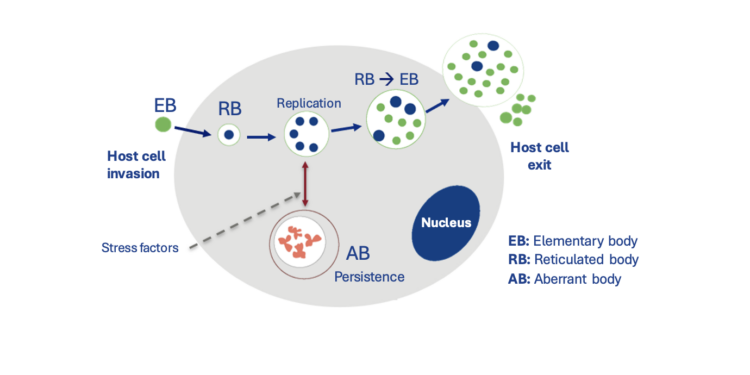
The animals show no signs of infection until they become pregnant, which is when the bacterium becomes active and causes abortion. This is where the second critical phase of the cycle comes in: excretion.
During the latency phase, it is impossible to identify the infected animals.
Sheep and goats that abort release large amounts of bacteria, contaminating the environment. This leads to other animals becoming infected and the disease spreading throughout the herd.
What warning signs can we see in the herd?
Our expert is clear on this:
– Abortions at the end of pregnancy
– Abortions clustered within 2–3 weeks
– Weak or dead lambs
– Typical placental lesions: necrotic cotyledons and thickened membranes
Chlamydia becomes active around day 90 of gestation, which is when it invades the placenta and causes abortion.
If an animal has an abortion, is it protected from future infections?
Laura answers this question that is commonly raised on farms. Animals that abort develop an immune response that can protect them from aborting in the future. However, this protection is neither complete nor permanent. This means that the animal remains infected for life and can infect other sheep in the flock.

The animals remain infected for life and will be contagious to other animals
Key factor in its control
Laura reveals the key to dealing with OEA: controlling excretion.
Large amounts of Chlamydia are excreted during and after abortion, with the foetus and placenta being the main sources of infection. This makes biosecurity measures and management essential during the birthing season.
In addition, we rely on an essential tool: vaccination helps to reduce the excretion of the pathogen and, therefore, bring down the infection pressure in the herd.
Conclusions
Our expert, Laura del Río, has helped to deepen our understanding of OEA. Chlamydia is difficult to control due to latency and its ability to spread. An effective control of OEA must therefore be rooted in prevention, which combines management, biosecurity and vaccination.
Watch the full interview and find the answers to any outstanding questions on OEA.
Article written by:
Tania Perálvarez Puerta. Global Product Manager, Small Ruminants Franchise – HIPRA